🪔 Preparing Our Inner Ayodhya to Welcome Shri Rama

Five Diyas, Four Chapters of the Bhagavad Gita, and One Beautiful Prayer
What If Shri Rama Came to Visit You?
Diwali is a time of joy, celebration, and light. We clean our homes, decorate them with beautiful rangoli, prepare delicious sweets, and light diyas to celebrate. One of the most beloved stories associated with Diwali is the return of Shri Rama to Ayodhya after fourteen years of exile and his victory over Ravana.
Imagine how excited the people of Ayodhya must have been! They wanted their city to look beautiful and welcoming for Shri Rama. But here’s an interesting question: What if Shri Rama were coming to visit us today? How would we prepare to welcome him?
Now imagine something even more special. What if Shri Rama wanted to visit not just our homes, but our hearts? What if each of us had a little Ayodhya within us? Just as we clean and decorate our homes for Diwali, could we also prepare our hearts to welcome Shri Rama?
Our Heart Is Our Inner Ayodhya
Shri Rama represents qualities such as truthfulness, kindness, courage, self-control, and dharma. If we wish to welcome these qualities into our lives, we must make room for them in our thoughts, words, and actions. This is what we mean by preparing our inner Ayodhya.

But how do we prepare our hearts? Luckily, we already have a wonderful guide: the Bhagavad Gita! Since the start of this year, we have been studying its first four chapters and discovering many valuable lessons from Shri Krishna’s teachings to Arjuna.
This Diwali, let’s connect those lessons to our celebration. Imagine that we have five special diyas to light in our inner Ayodhya. The first four represent values inspired by the four chapters we have studied. The fifth represents something equally important: our prayer to keep learning and growing.
🪔 Diya 1: Humility — Being Willing to Learn
In Chapter 1 of the Bhagavad Gita, we meet Arjuna on the battlefield of Kurukshetra. Although Arjuna is a brave and skilled warrior, he becomes overwhelmed by confusion and sadness. He is unsure about what he should do and eventually turns to Shri Krishna for guidance.
Sometimes, we experience something similar. Perhaps we do not understand a lesson in school, struggle to make a decision, or feel confused about what is right. We may hesitate to ask questions because we worry about what others will think.
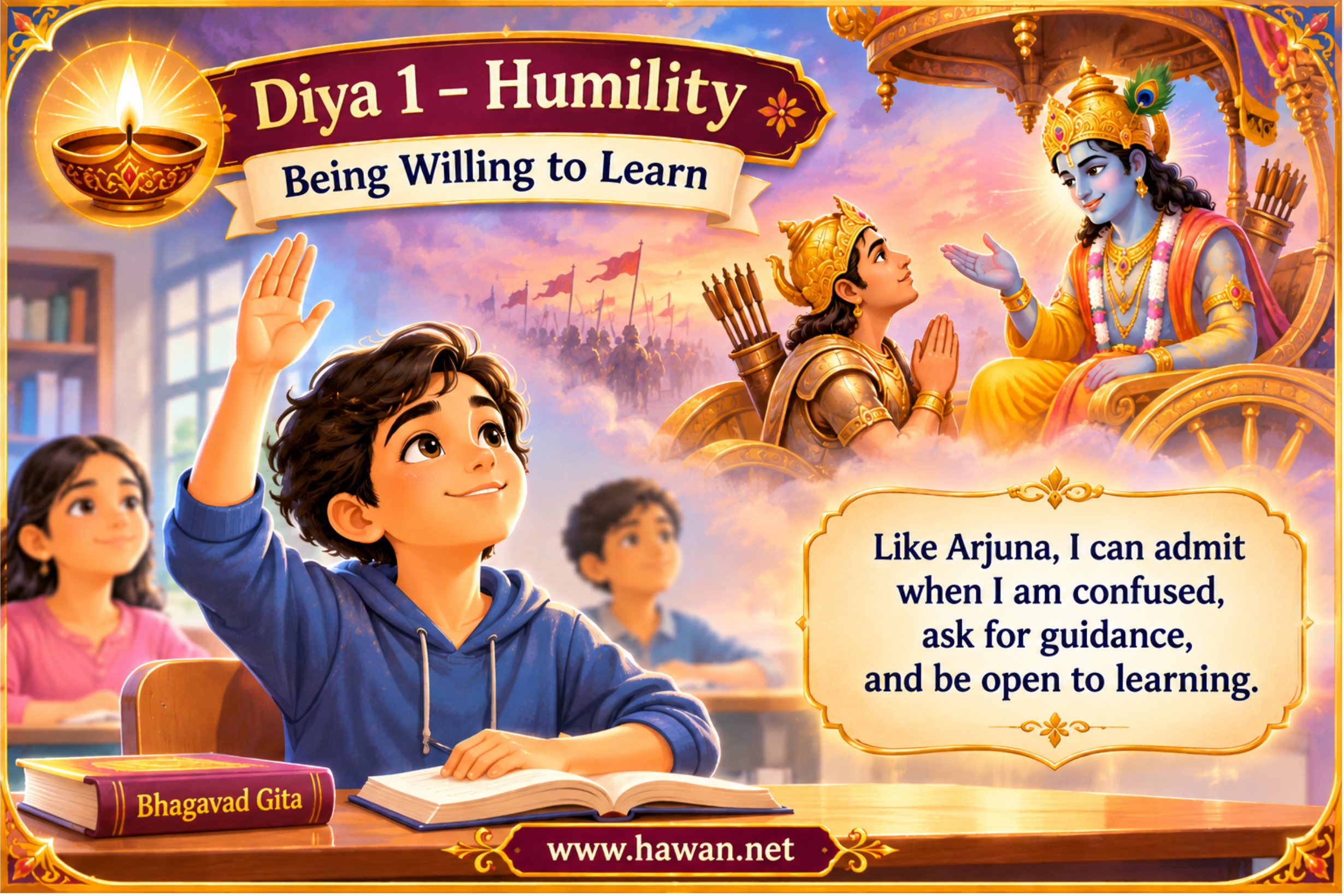
Arjuna’s experience reminds us that being confused does not make us weak, and asking for help can be the beginning of wisdom. Humility means accepting that we do not know everything and being willing to learn from others. When we let go of the attitude that we must always have the answers, we make room for knowledge to enter our hearts.
Our first diya is the diya of humility. By lighting it, we remind ourselves to remain curious, ask questions, listen carefully, and seek guidance when we need it.
🪔 Diya 2: Sincere Effort — Doing Our Best
In Chapter 2, Shri Krishna teaches Arjuna an important lesson about performing our duties without becoming attached to the results. We should focus on doing what is right and giving our best effort, rather than allowing success or failure to control our happiness.
Think about preparing for a school competition, practicing a musical instrument, or studying for an exam. We may work very hard and still not win first place or receive the highest marks. Does that mean all our effort was wasted? Certainly not! We learn, improve, and become stronger through our efforts.

Shri Rama also gives us a beautiful example. When he learns that he must leave Ayodhya and live in the forest, he accepts the responsibility before him rather than clinging to the kingdom he was about to receive. His actions remind us that doing our duty matters even when the outcome is not what we hoped for.
Our second diya is the diya of sincere effort. It reminds us to work hard, do what is right, and accept results with a balanced mind. Success is wonderful, but sincere effort and the lessons we learn along the way are valuable too.
🪔 Diya 3: Selfless Service — Helping Without Expecting Rewards
In Chapter 3, Shri Krishna teaches us about Karma Yoga, the path of performing our duties with the right attitude. Our actions become spiritually meaningful when we perform them without selfish attachment and with a spirit of service.
One of the best examples of selfless service in the Ramayana is Shri Hanuman. He crosses the ocean to find Sita, brings the Sanjeevani-bearing mountain to help save Lakshmana, and performs countless acts of courage and devotion. He does all this out of love and dedication to Shri Rama, not because he wants fame or rewards.

We may not be able to leap across oceans like Hanuman, but we can certainly follow his example in small ways. Helping our parents, sharing with a friend, including someone who feels left out, or cleaning up without being asked are all opportunities to practice selfless service.
Our third diya is the diya of selfless service. It reminds us that even small actions can make a big difference when they are performed with kindness and without expecting something in return.
🪔 Diya 4: Wisdom in Action — Having the Courage to Do What’s Right
In Chapter 4, Shri Krishna explains the importance of spiritual knowledge, the restoration of dharma, and the deeper understanding of action. True wisdom is not simply remembering what we have learned. It is allowing that knowledge to guide our decisions and actions.
The Ramayana gives us a beautiful example through Bharata, Shri Rama’s younger brother. When Bharata learns that his mother, Kaikeyi, has arranged for Rama to be sent into exile so that Bharata can become king, he faces a difficult choice. He could accept the throne and enjoy the power and comforts of being king, even though he knows that what happened to Rama was unfair.

But Bharata understands that just because something benefits us does not mean it is right. He refuses to take the throne for himself and instead places Shri Rama’s sandals on it, ruling Ayodhya as Rama’s representative until his return. Bharata shows us that true wisdom means choosing dharma over personal gain, even when that choice is difficult.
We face our own choices every day. We may know that telling the truth is important, but what happens when telling the truth could get us into trouble? We may know that fairness matters, but what if we benefit from something unfair? Doing what is right is not always the easiest choice, especially when doing the wrong thing might benefit us.
Our fourth diya is the diya of wisdom in action. It reminds us to think carefully, recognize what is right, and find the courage to act according to our values. Knowledge becomes truly meaningful when we put it into practice.
🪔 Diya 5: Inner Growth — May the Light of Knowledge Keep Growing
Now imagine our inner Ayodhya glowing with four beautiful diyas: humility, sincere effort, selfless service, and wisdom in action. These four diyas represent some of the wonderful lessons we have learned from the first four chapters of the Bhagavad Gita.
But our journey has only just begun! We have completed four chapters, and there is so much more to learn. Even the lessons we already know can become more meaningful as we think about them, ask questions, and apply them in different situations.
Think about how one small diya can light another, and that diya can light another. Soon, an entire room can glow with light. Knowledge is like that flame. Each new lesson can remove a little more darkness from our understanding, while every good action helps that knowledge become wisdom.
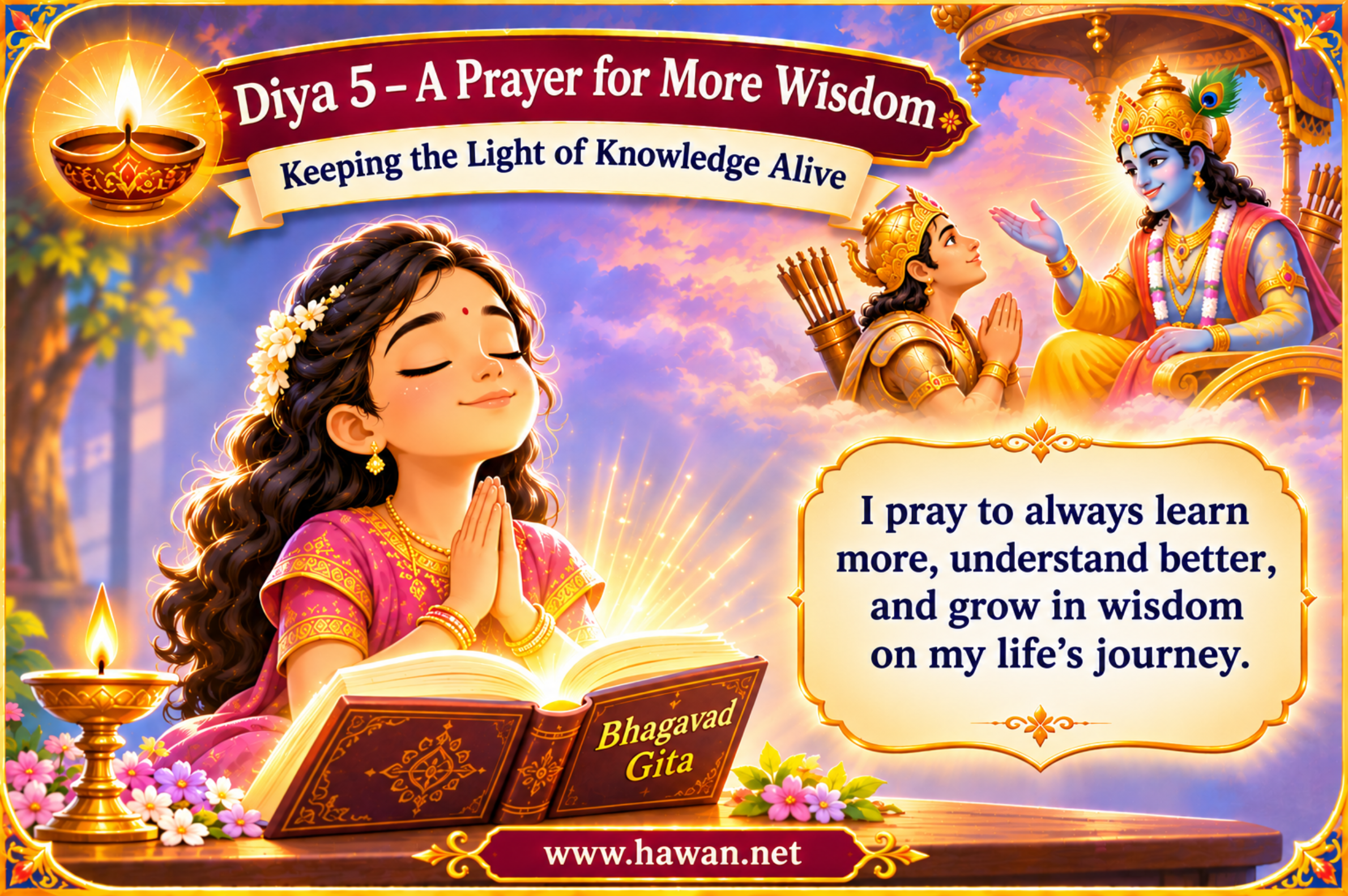
This is why our fifth diya is different from the first four. It does not represent another chapter or another lesson. Instead, it represents our prayer for continued inner growth. We pray that the knowledge we gain from studying the Gita will help us become wiser, kinder, more thoughtful, and more courageous.
The fifth diya also reminds us to remain lifelong learners. Studying the Gita is not simply about completing chapters or remembering shlokas. It is about slowly transforming our thoughts, choices, and actions so that the light of wisdom shines more brightly within us.
🙏 Our Prayer for the Fifth Diya
Dear Shri Krishna and Shri Rama, thank you for giving us the opportunity to learn from the Bhagavad Gita and the Ramayana. May the light of knowledge remove the darkness of ignorance from our hearts and help us better understand ourselves and the world around us.
Please give us the humility to keep learning, the determination to do our best, the kindness to serve others, and the wisdom and courage to do what is right. Help us remember these lessons not only during our classes, but also in our everyday lives.
As we continue our journey through the Bhagavad Gita, may our understanding deepen and our actions become more thoughtful and compassionate. May we grow a little wiser and a little better every day, and may our inner Ayodhya always shine with the light of dharma.
🌟 Are You Ready to Welcome Shri Rama?
This Diwali, as we light diyas in our homes, let’s remember the five diyas we can light within ourselves. The first four remind us of the values we have learned, while the fifth reminds us to keep growing through knowledge, reflection, prayer, and practice.
Before our upcoming Diwali session, take a few minutes to think about your own experiences. Which of the four values do you practice most often? Which one would you like to improve? Can you remember a time when you acted like Arjuna, Shri Rama, Hanuman, or Bharata?

Your Special Diwali Reflection Assignment: Write a short paragraph about one time you acted like one of these four characters. Describe what happened, what prompted you to act that way, and how you felt afterward. Did someone need your help? Did you face a difficult choice? Did you choose to do the right thing even when it was hard? Or did you give your best effort even though you were unsure of the result?
As you write, think about which of the four Gita values your actions reflected. What did you learn from the experience? Would you make the same choice again? There are no perfect answers. The goal is to recognize how the lessons of the Gita are already becoming part of our everyday lives.
Bring your reflections to our special Diwali session. We will explore four everyday situations that challenge us to apply what we have learned from the Gita. Together, we will light our four diyas and conclude by lighting the fifth with a prayer for everyone’s continued inner growth.
Diwali reminds us to light up our homes. The Bhagavad Gita inspires us to light up our minds and hearts. And by living its teachings, we prepare our inner Ayodhya to welcome Shri Rama.
May the light of knowledge become the light of wisdom, and may that wisdom guide our actions every day.
🪔Jai Shri Ram! Jai Shri Krishna! Happy Diwali! 🪔
Regards,
Harsh Mendiratta
www.hawan.net