Five Lessons for a Strong and Steady Mind – Bhagwat Gita Chapter 2 (April 2026)

The last chapter of the Gītā ends with Arjuna feeling overwhelmed. He is not ready, not confident, and not sure what to do next. That moment may sound dramatic, but it is actually very familiar. Many of you have probably had times when your thoughts feel tangled, your emotions feel too strong, and even a simple decision suddenly feels heavy. That is why Chapter 2 matters so much. It does not begin with everything being solved. It begins with confusion, and then slowly moves toward clarity. Krishna does not simply tell Arjuna to “be strong.” He helps him understand what is happening inside his mind and how to respond in a wiser way. In this chapter, you begin to see that real strength is not about never feeling afraid, sad, or unsure. Real strength is learning how to stay steady, think clearly, and do what is right even when life feels difficult, and that’s the topic for this month’s assignment.
As we go over Chapter 2, it may help to keep a simple framework in mind. These five ideas can help connect Arjuna’s journey with your own experiences, choices, and struggles.
A helpful way to understand Chapter 2 is through five simple ideas that you can carry into everyday life. First, confusion can be the starting point of wisdom. Second, you are deeper than your changing feelings and situations. Third, you grow by doing the right thing, even when it is hard. Fourth, you should focus on your effort rather than getting stuck on results. And fifth, true strength comes from a steady mind. Together, these five ideas give you a framework for understanding not only Arjuna’s journey, but also your own thoughts, choices, and struggles.
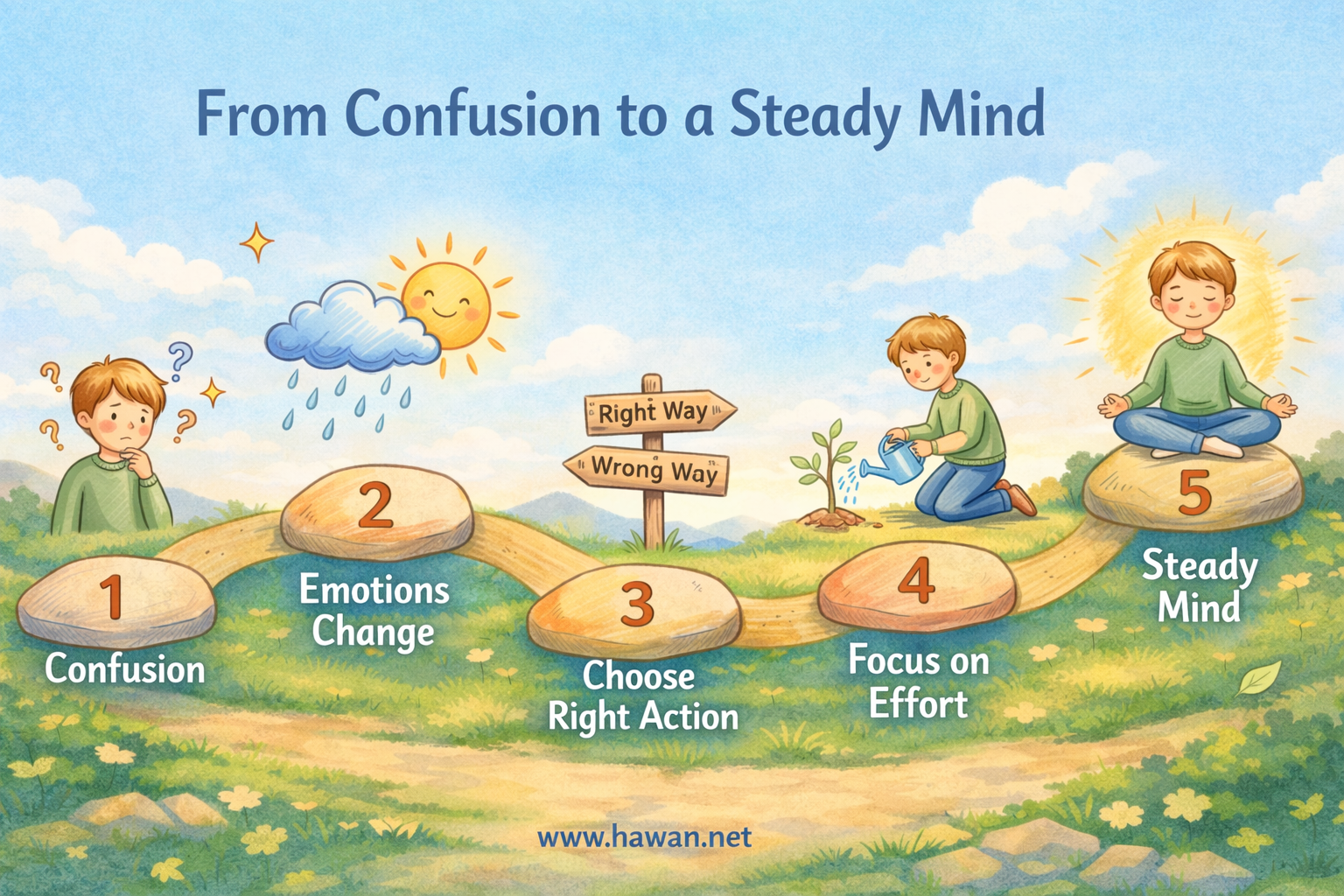
1. Confusion Can Be the Starting Point of Wisdom
On the battlefield, Arjuna is standing between two armies, unsure and overwhelmed, just like you might feel when you are stuck between two difficult choices.
Chapter 2 begins at a moment when Arjuna is deeply confused, and that is exactly why it matters. He is not hiding his emotions or pretending to be strong when he does not feel strong. You may go through the same thing before a big exam, after a fight with a friend, or when you feel torn between what you want and what you know is right. In those moments, confusion can feel like weakness, but the Gītā shows that it can actually be the beginning of deeper understanding. When you admit that you are struggling, you open the door to learning, reflection, and growth.
2. You Are Deeper Than Your Changing Feelings
Even though Arjuna feels fear and sadness when he looks at the battlefield, Krishna reminds him that these feelings do not define who he truly is.
Krishna helps Arjuna see that feelings are real, but they are not the whole of who we are. You might feel like a failure after one bad grade or feel unwanted after being left out of a group, but those moments do not define your whole self. Feelings rise and fall, just like the weather changes from one day to the next. Chapter 2 reminds you that there is something steadier inside you than fear, sadness, excitement, or embarrassment. That idea can help you avoid getting completely carried away by every passing emotion.
3. Do the Right Thing Even When It Is Hard
Right there in the middle of the battlefield, Arjuna has to choose between walking away from his duty or doing what he knows is right, even though it feels difficult.
One of the strongest messages of this chapter is that doing the right thing is not always easy. You may know it is right to tell the truth, include someone who is being ignored, or keep trying even after failure, but that does not mean it feels comfortable in the moment. Arjuna wants to step away from a painful situation, yet Krishna begins teaching him that we cannot choose only by what feels easiest. Real growth happens when you act from values rather than from fear or pressure. That kind of courage may look quiet on the outside, but it is powerful on the inside.
4. Focus on Effort, Not Just Results
Krishna reminds Arjuna that he must focus on his actions in the battle, not on winning or losing, because the outcome is not fully in his control.
This chapter teaches a lesson that can help you in almost every part of life: give your best effort, but do not let your peace depend completely on the result. You can study hard and still feel nervous during the test. You can practice every day and still not win the game or get the part you wanted. If you only feel good when everything turns out exactly the way you hoped, life will keep pulling you up and down. Krishna’s guidance helps you see that effort, sincerity, and commitment matter deeply, even when outcomes are uncertain. That mindset makes you stronger, calmer, and more resilient.
5. True Strength Comes from a Steady Mind
While everything around him is noisy and tense on the battlefield, Krishna is guiding Arjuna toward a calm and steady mind before he takes action.
At the heart of Chapter 2 is the idea that true strength is not just physical power or outer success. True strength is the ability to stay balanced when life feels confusing, unfair, exciting, or disappointing. A steady mind does not mean never feeling upset; it means not letting every feeling take control of your choices. For you, this might mean staying calm before a competition, listening before reacting in anger, or not giving up after one hard day. The Gītā shows that inner steadiness grows slowly, and that steady growth is one of the greatest strengths you can build.
Now that you have this framework in mind, take some time to reflect on it personally. These questions are meant to help you think about how the chapter connects with your own life, not just Arjuna’s.
Assignment for this month:
This chapter introduces several important ideas, and each of them deserves deeper exploration. Over the next few months, we will take time to “double click” on some of these ideas and understand them more fully, one by one.
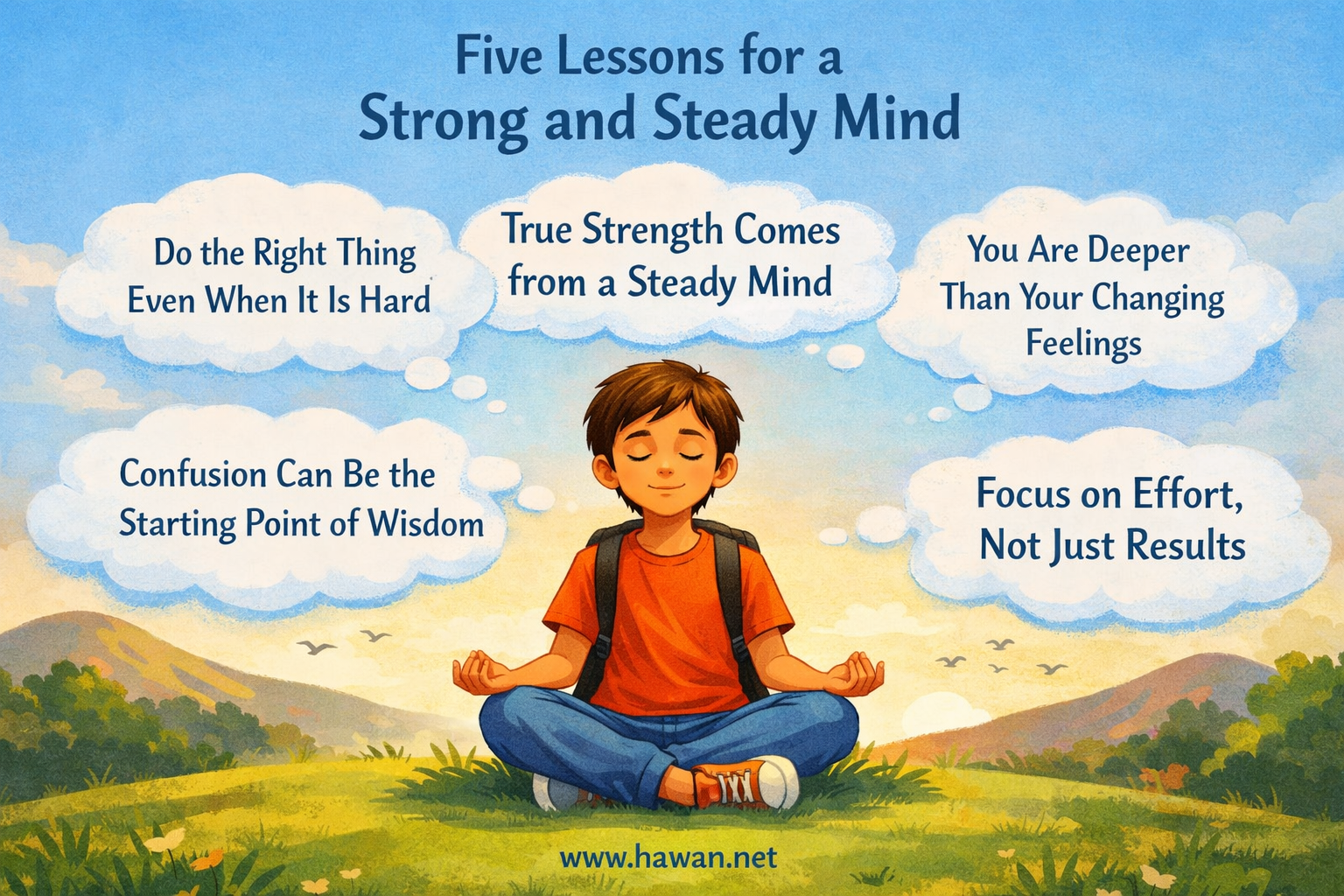
For this month, I want you to focus on building a simple, high-level understanding of all five key lessons we discussed. You are not expected to go very deep into any one idea yet. Instead, your goal is to understand what each lesson means in your own words and how it might connect to your life. For the assignment, please keep your answers brief.
- Why does the chapter begin with confusion instead of confidence?
- How are you more than your changing emotions?
- Why is focusing only on results stressful?
- What is the difference between reacting emotionally and acting wisely?
- Why does wisdom grow slowly rather than instantly?
Please think of this framework as building a foundation. Once that foundation is clear, we will come back and explore some of these ideas in much greater detail in the coming months.
Regards,
Harsh Mendiratta
www.hawan.net