What Are We Passing On?
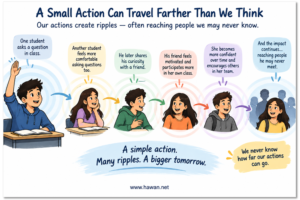
Is everything you do fully chosen by you? Have you ever wondered why you do some of the things you do? Maybe you use an expression that someone in your family always uses. Maybe you greet people in a particular way, become quiet when you are upset, check your phone whenever there is a pause, ask lots of questions in class, or avoid asking questions completely. We often think our behavior is simply ours. BTW, that’s where Arjun got confused, too. Shri Krishana reminded him of his influence. And, if we look carefully, we will find pieces of other people’s behavior inside our habits. The interesting part is this: many of those people were never trying to teach us anything.
Influence Happens Even When Nobody Is Trying to Set an Example
Last month, while exploring Chapter 3 of the Bhagavad Gita, we discussed how our actions affect the people around us. We talked about setting an example and being a role model. But there is something even deeper in that teaching. We do not learn only from people we officially consider “role models.” We are constantly observing, absorbing, and influencing one another, often without realizing it. A child watches how parents treat grandparents. A student watches how classmates respond to a wrong answer. A younger sibling watches how an older sibling speaks at home. Nobody announces, “This is the lesson.” Still, something is being learned.
We Become What We See Around Us
What we pick up does not always have to be clearly good or bad. Maybe everyone in your house greets a person when they enter. Maybe everyone eats quickly. Maybe nobody talks much in the morning. Maybe your friends use certain expressions. Maybe one class automatically becomes quiet when the teacher enters, while another class does not. These may seem like neutral behaviors, but they do matter too. Over time, what we see repeatedly becomes “how things are done.” This is one quiet way influence works: it turns behavior into normal.
See How We Create the Room Without Even Realizing
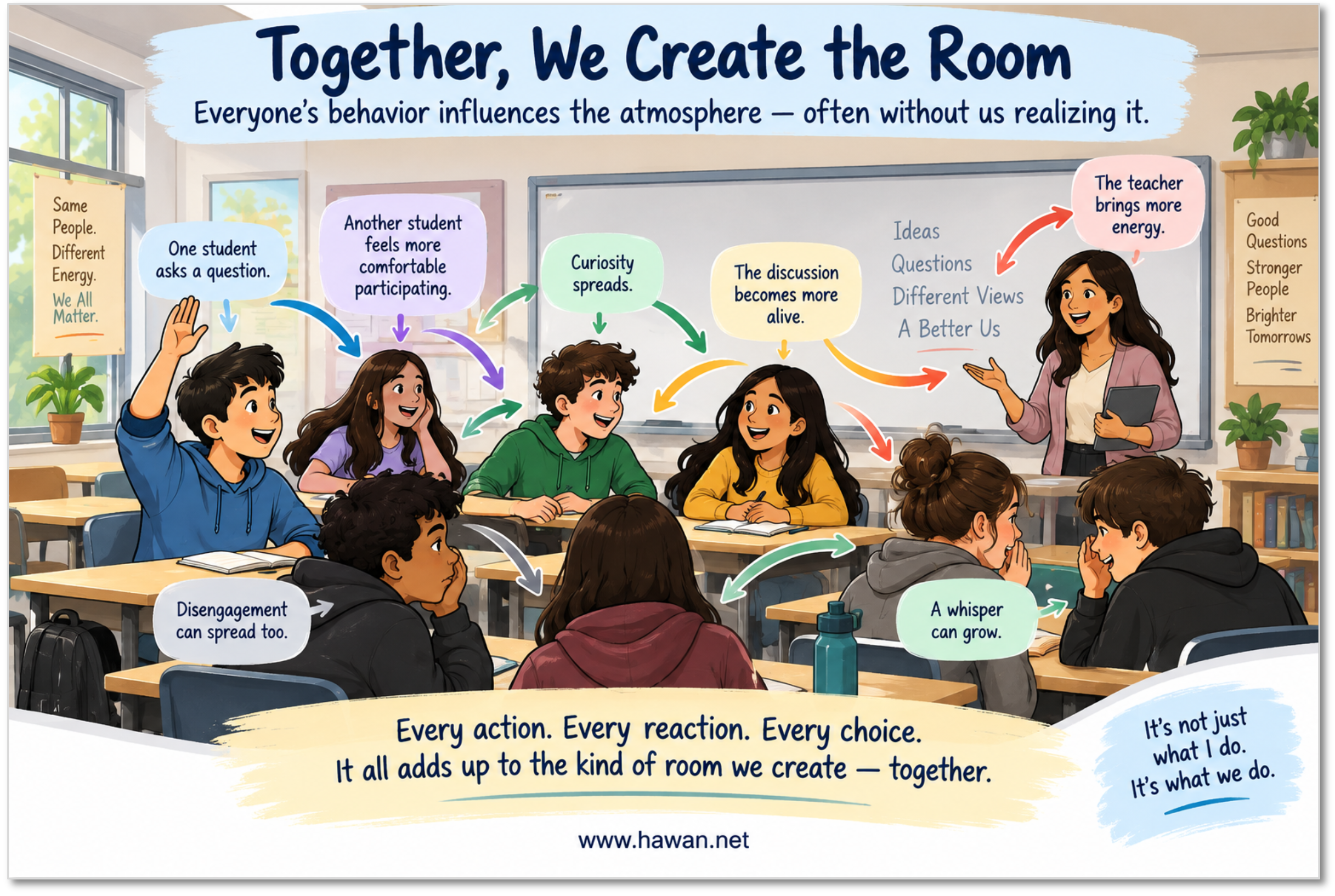
A classroom makes this invisible influence easier to see. One student raises a hand and asks the question everyone else was afraid to ask, and suddenly asking questions feels a little more normal. Someone laughs at a wrong answer, and another student becomes less willing to participate. Someone listens with genuine interest, and the discussion becomes more alive. Even the teacher is affected: a curious class can bring out more energy, while a disengaged class can change the mood of the room. So who influenced whom? Everyone influenced everyone. Together, we create the room.
And, I Am Passing Things On Too
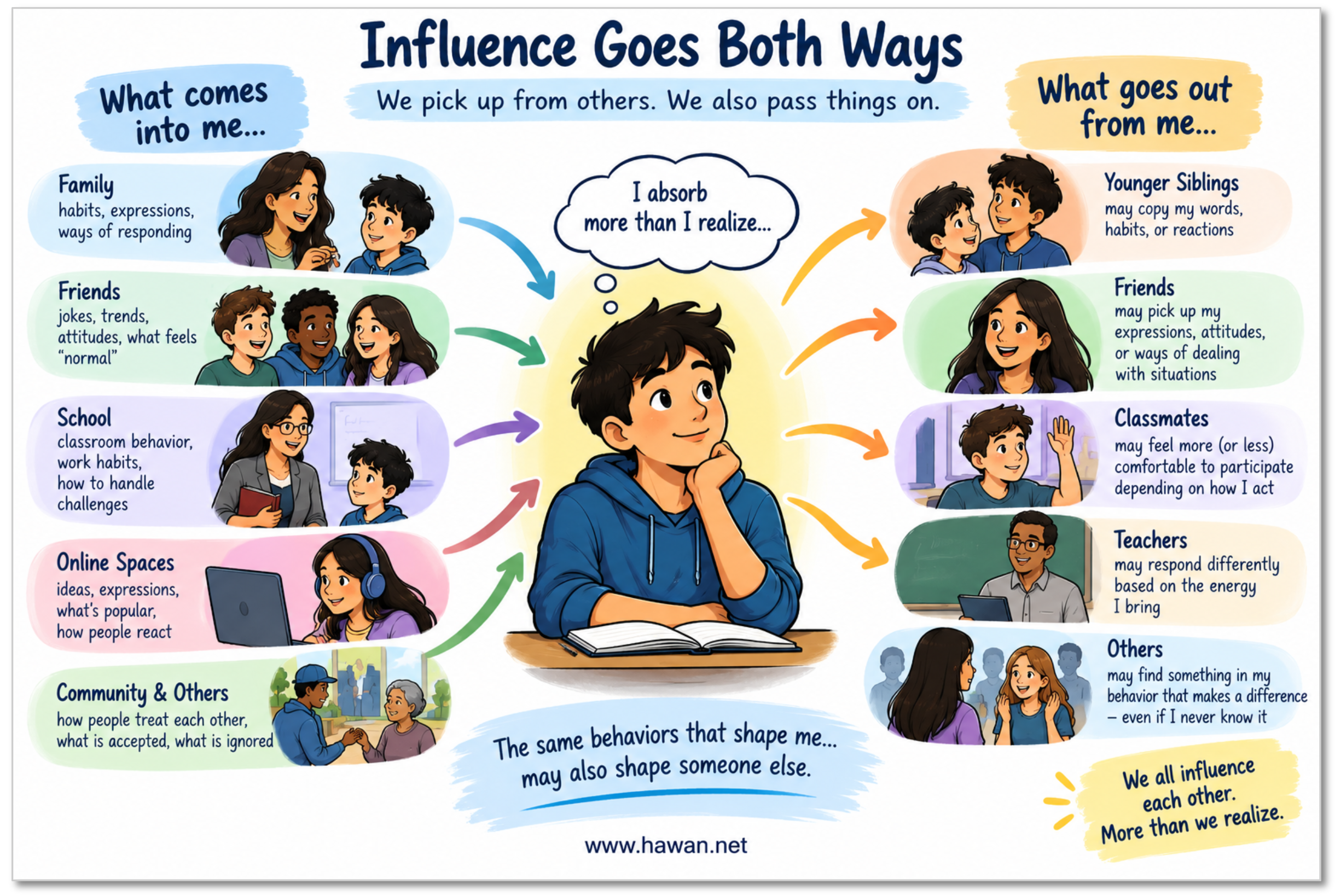
Once we see that everyone helps create the room, the question becomes more personal. If the people around me help shape what feels normal to me, then I am also helping shape what feels normal to them.
Maybe a younger sibling copied the way you speak to your parents. Maybe a friend started using an expression you use. Maybe someone became more comfortable making a certain joke because you laughed at it. Maybe someone became more comfortable asking questions because you did. Positive, negative, or neutral, it all counts. Your actions may be teaching even when you do not feel like a teacher.
This is where Chapter 3 becomes very practical. Our actions do not stop with us. They enter families, classrooms, teams, friendships, and online spaces. Other people respond to them, and sometimes they pass them further.
Awareness, Not Perfection
This is not about becoming nervous that everyone is watching you. It is not about being perfect, and it is not about controlling what everyone learns from you. That would be impossible. The point is awareness.
We are constantly receiving signals from people around us about what is normal, acceptable, funny, respectful, brave, or embarrassing. At the same time, we are sending signals of our own. Most of those signals will never feel important when we send them. But their effect may travel further than we ever see.
Assignment: What Am I Helping Make Normal?
Chapter 3 reminds us that our actions matter beyond ourselves. So perhaps the real question is not only, “What am I doing?” It is also: What am I passing on?
This month, pause and observe your own world. You do not need to judge everything immediately. Just notice. Think about these questions and jot them down:
- What is one habit, expression, or behavior I have picked up from someone else?
- What is one behavior that feels “normal” (but isn’t or shouldn’t) in my class, family, team, or friend group?
- What is one thing someone may have picked up from me without my realizing it?
- What is one behavior I want to help make more normal around me?
Make us proud!
Harsh Mendiratta
www.hawan.net