Karma Yoga – Chapter 3 of the Bhagavad Gita (August 2026)
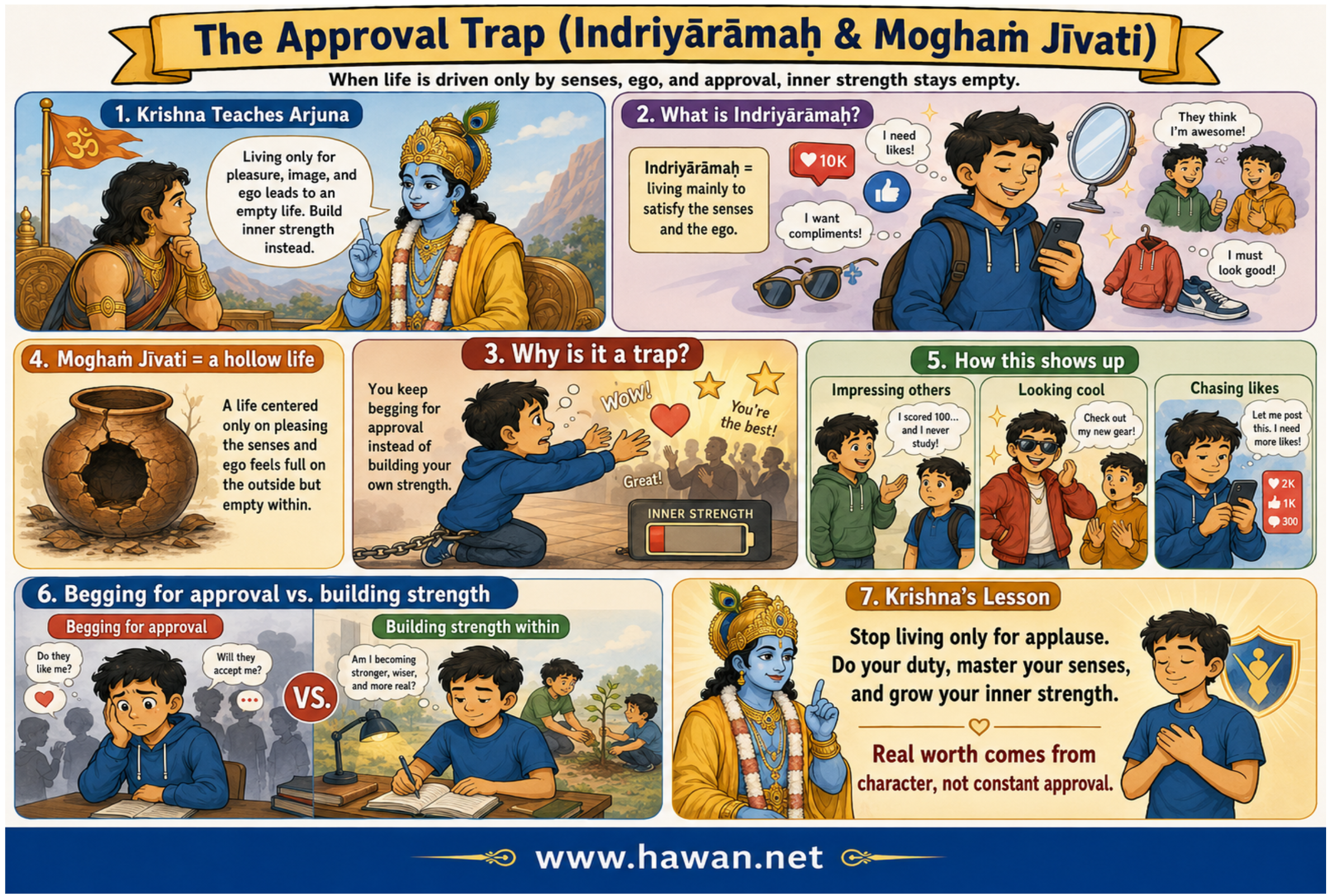
Imagine you spent an hour taking the perfect picture, thinking of a clever caption, or practicing a trendy challenge just to post it online. You press “share” and wait. Your eyes are glued to the screen. 10 likes… 50 likes… 100 likes! You get a massive rush of excitement. You feel like you’re on top of the world.
But on your next post, the notifications barely move. Your friends don’t double-tap. Or maybe at school, the “cool crowd” doesn’t give you the reaction you wanted.
Suddenly, your energy completely crashes. You feel invisible, bored, and kinda down.
When we do things just to look cool, impress friends, or earn likes from people we barely even meet, we are putting our “remote control” in someone else’s hands. We are plugging ourselves into a “wall outlet” of other people’s opinions. If they pull the plug—by ignoring us or leaving us on read—we completely freeze and shut down.
In Chapter 3 of the Bhagavad Gita (Karma Yoga – The Yoga of Action), Sri Krishna calls this trap Indriyārāmaḥ (living solely to satisfy our senses and ego). He warns that living this way is a “hollow” or “empty life” (Moghaṁ Jīvati) because we are constantly begging for approval instead of building our own strength. And, that’s the topic of this month’s assignment for the Hawan kids.
Krishna shows Arjuna how to unplug from the crowd and build an internal battery that keeps us strong, steady, and self-powered, no matter how many “likes” we get.
Here are the four key learnable moments from Chapter 3 that show us how to build that internal battery:
1. The “Can’t Hit Pause” Rule (Inaction is Impossible)
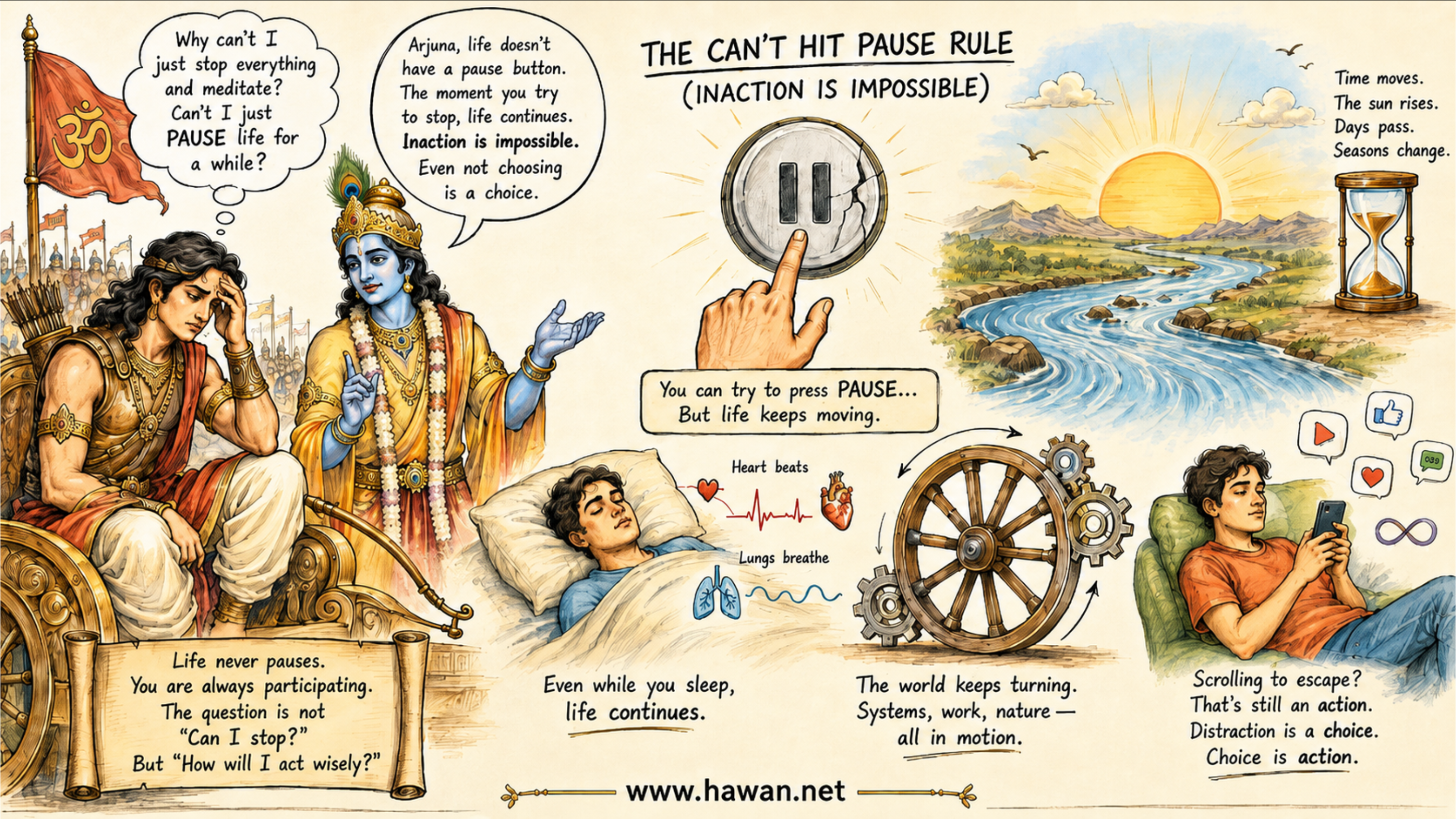
After learning about the quiet, steady mind in Chapter 2, Arjuna gets confused. He asks Krishna: “If having a calm, wise mind is the most important thing, why do I still have to do this hard work? Why can’t I just sit quietly, hit pause on life, and meditate?“.
Krishna smiles and explains a fundamental law of the universe: No one can remain inactive, even for a single second. Even when you are sleeping, your heart is beating, your lungs are breathing, and your body is working.
You can’t run away from action. Trying to avoid your responsibilities or scrolling on your phone to “escape” isn’t doing nothing—it’s just a passive choice. Since we have to act every single day, the real secret of life is learning how to turn our actions into our strength.
2. Karma Yoga to Yajna (Living the spirit of Yajya)
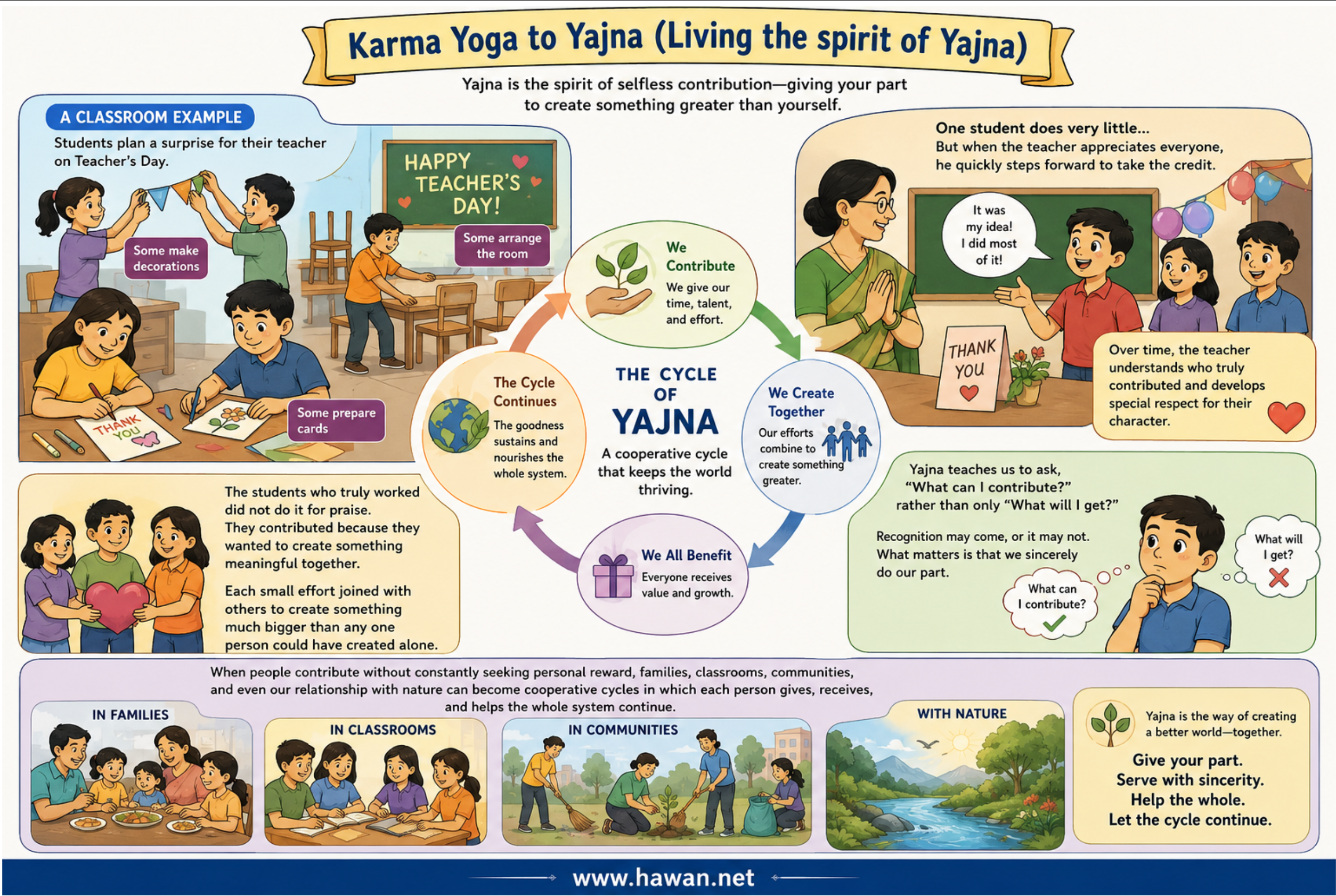
Krishna explains that the world works through a beautiful cooperative cycle called Yajna, selfless contribution. Imagine a group of students preparing a surprise for their teacher on Teacher’s Day. Some make decorations, some arrange the room, and others prepare cards. One student, however, does very little. But when the teacher sees the surprise and appreciates everyone’s effort, that student quickly steps forward and tries to take the credit. Over time, however, the teacher comes to understand who genuinely contributed and develops a special respect for their character.
The students who truly worked had not done it for praise. They contributed because they wanted to create something meaningful together. Each student’s small effort joined with the efforts of others to create something much bigger than any one person could have created alone. The teacher’s appreciation was valuable, but even without it, their contribution had already served its purpose. This spirit of giving your part to something larger than yourself is Yajna.
Yajna teaches us to ask, “What can I contribute?” rather than only “What will I get?” Recognition may come, or it may not. What matters is that we sincerely do our part. When people contribute without constantly seeking personal reward, families, classrooms, communities, and even our relationship with nature can become cooperative cycles in which each person gives, receives, and helps the whole system continue.
3. Unmasking the Sneaky “Mind Robbers” (Kama & Krodha)
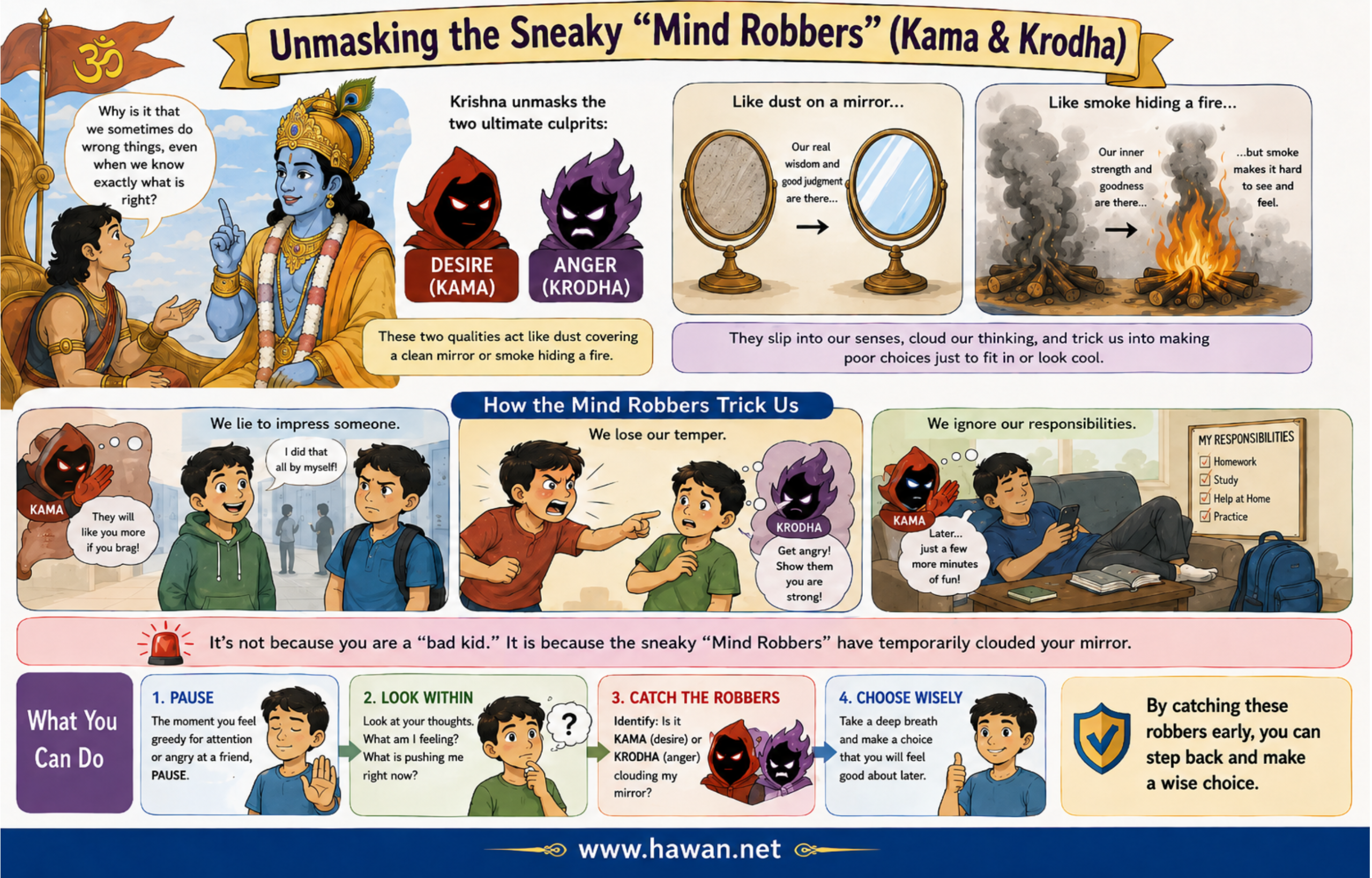
Arjuna asks a question we have all wanted to ask: “Why is it that we sometimes do wrong things, even when we know exactly what is right?”
Krishna unmasks the two ultimate culprits: Desire (Kama) and Anger (Krodha). He explains that these two qualities act like dust covering a clean mirror or smoke hiding a fire. They slip into our senses, cloud our thinking, and trick us into making poor choices just to fit in or look cool.
When you lie to impress someone, lose your temper, or ignore your responsibilities, it’s not because you are a “bad kid.” It is because the sneaky “Mind Robbers” have temporarily clouded your mirror. The moment you feel greedy for attention or angry at a friend, pause. Look at your thoughts. By catching these robbers early, you can step back into your steady “sky” (from Chapter 2) and make a wise choice.
4. The Role-Model Effect (Loka-sangraha)
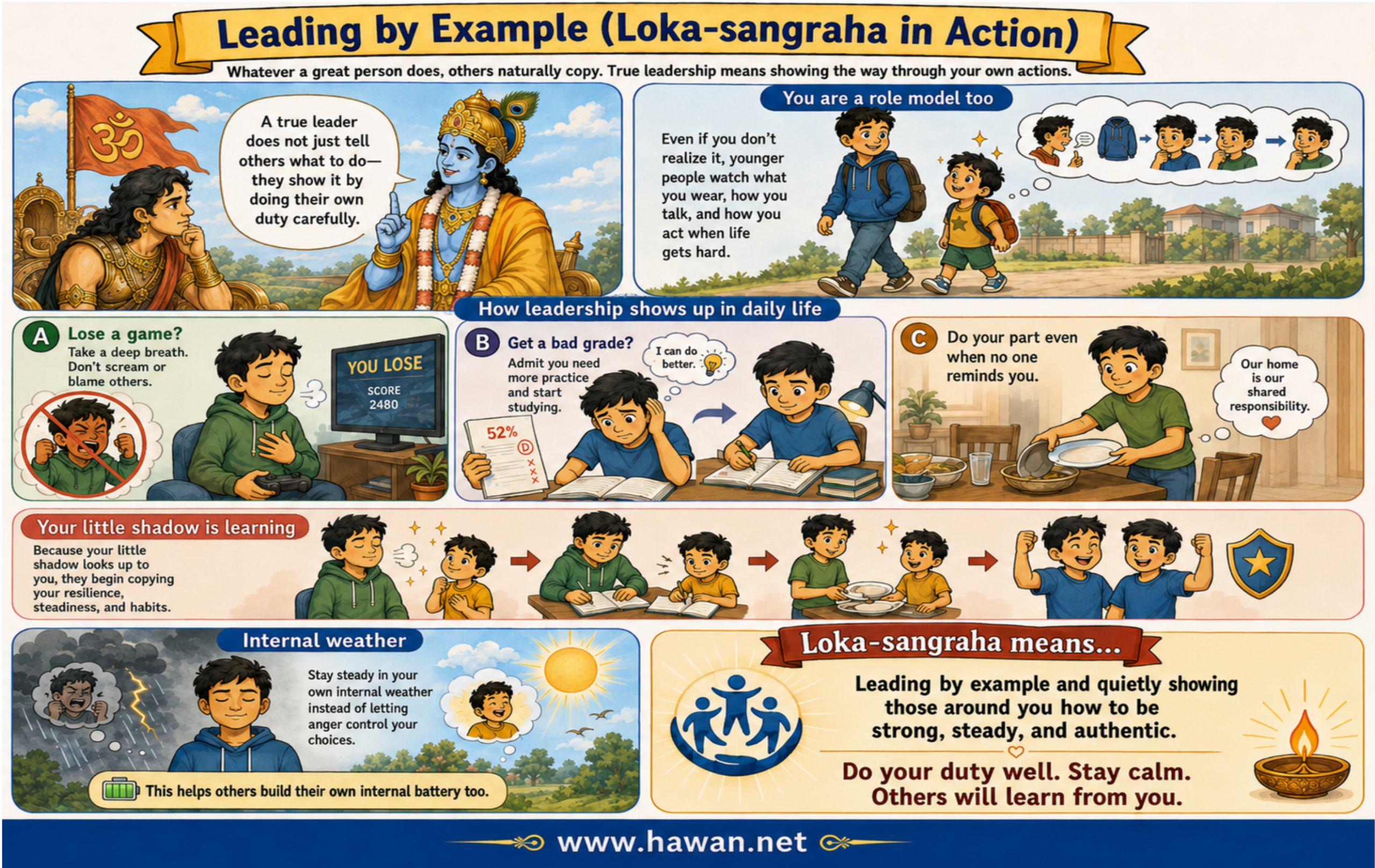
Krishna tells Arjuna that whatever a great person does, others will naturally copy. A true leader doesn’t stand around telling people how to act; they show them by performing their own duties meticulously.
You may not know it but you are a role model for others. Others (for example, a younger sibling or a younger cousin who follows you around) watch what you wear, how you talk, and how they see you react when you are frustrated.
When you lose a video game or get a bad grade, instead of throwing a tantrum, screaming, or blaming the teacher, you take a deep breath, admit you need to practice more, and start studying. Or, you simply clear your own plate after dinner without your parents even asking.
Because your “little shadow” looks up to you, they start copying your resilience and your habits. By learning to stay steady in your own “internal weather” rather than letting anger take control of your choices, you are teaching them how to build their own internal battery, too. That is Loka-sangraha in action—leading by example and quietly showing those around you how to be strong, steady, and authentic
This Month’s Assignment: “Powering Your Internal Battery”
(This month, we want to hear your real, honest stories—no cheesy or scripted answers!)
Please choose one of the prompts below and prepare a quick 1 to 2-minute reflection for our upcoming Hawan:
- The Wall Plug vs. The Battery: Think of something you do (like practicing an instrument, studying, playing a sport, or choosing your clothes). Describe a time you did it just to “look cool” or get praise (waiting for a plug) versus a time you did it simply because you knew it was your gear to turn (running on your battery). How did your energy feel different?
- The Stalled Engine: Have you ever decided not to turn your gear (e.g., ignoring a family chore or refusing to help a friend) because you felt there was “nothing in it for you”? How did that passivity “stall” the engine for the people around you?
- Catching the Robbers: Share a time when the desire to “fit in” or “impress someone” almost made you do something you knew was wrong. How did you spot that “Mind Robber” and clear the dust off your mind’s mirror?
- The Quiet Leader: Describe a situation where you chose to do the right thing instead of trying to look “cool” or popular. How did your silent action set a standard and show others how to be brave?
Building a steady mind and a pure heart is a slow, beautiful journey. Every time you choose to turn your gear without demanding a reward, you add a solid brick to your inner foundation. We can’t wait to hear your stories and insights at our next monthly Hawan!
Regards,
Harsh Mendiratta
www.hawan.net